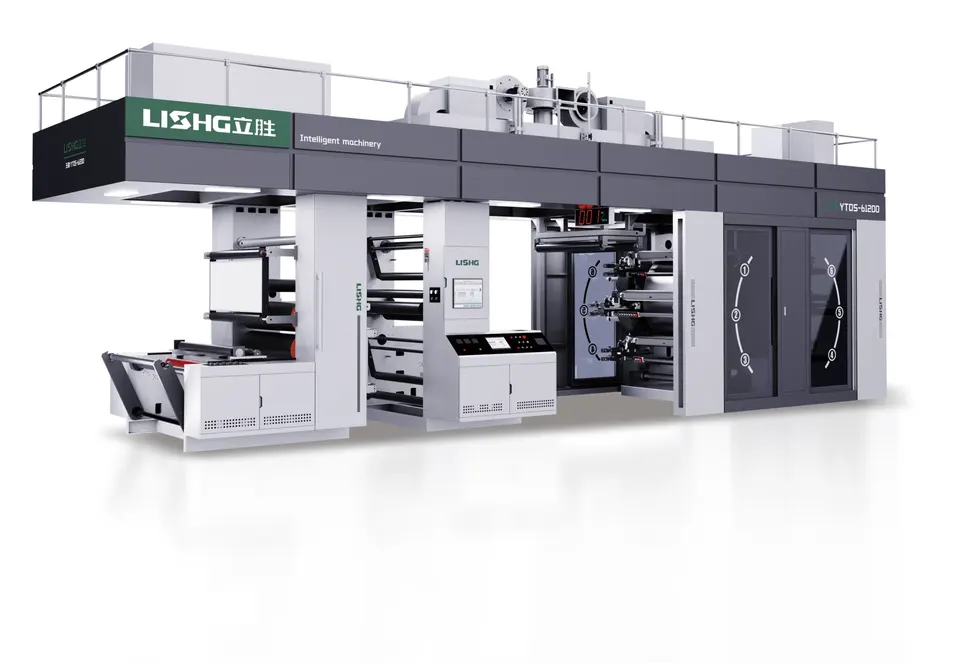
THE KEY QUESTION
What Is the Real Speed Limit of a CI Flexo Press?
Short Answer
The practical speed limit is usually reached when print quality, register, web stability, ink transfer or drying can no longer remain within the required production tolerance. The highest number on a machine specification sheet is therefore not automatically the speed a packaging converter can sustain on every job.
For flexible packaging production, usable speed is determined by the complete production chain. The substrate must remain stable, web tension must stay within its working window, color registration must remain controlled, ink must transfer consistently, and the drying system must remove sufficient solvent or water before the printed web reaches the next process stage.
For overseas buyers, this distinction is important because a higher nameplate speed is valuable only when the complete machine configuration can support that speed under the actual production conditions.
01 · SUBSTRATE
Stretch, gauge, surface and heat sensitivity define the working window.
02 · DRYING
Higher speed reduces residence time and increases drying demand.
03 · TENSION
Thin films can stretch, flutter or wrinkle when tension becomes unstable.
04 · REGISTER
Color-to-color accuracy becomes harder to maintain as speed increases.
Bottom line: usable speed is the highest production speed at which drying, tension, register, ink transfer, density and substrate behavior remain inside the quality window required by the job.
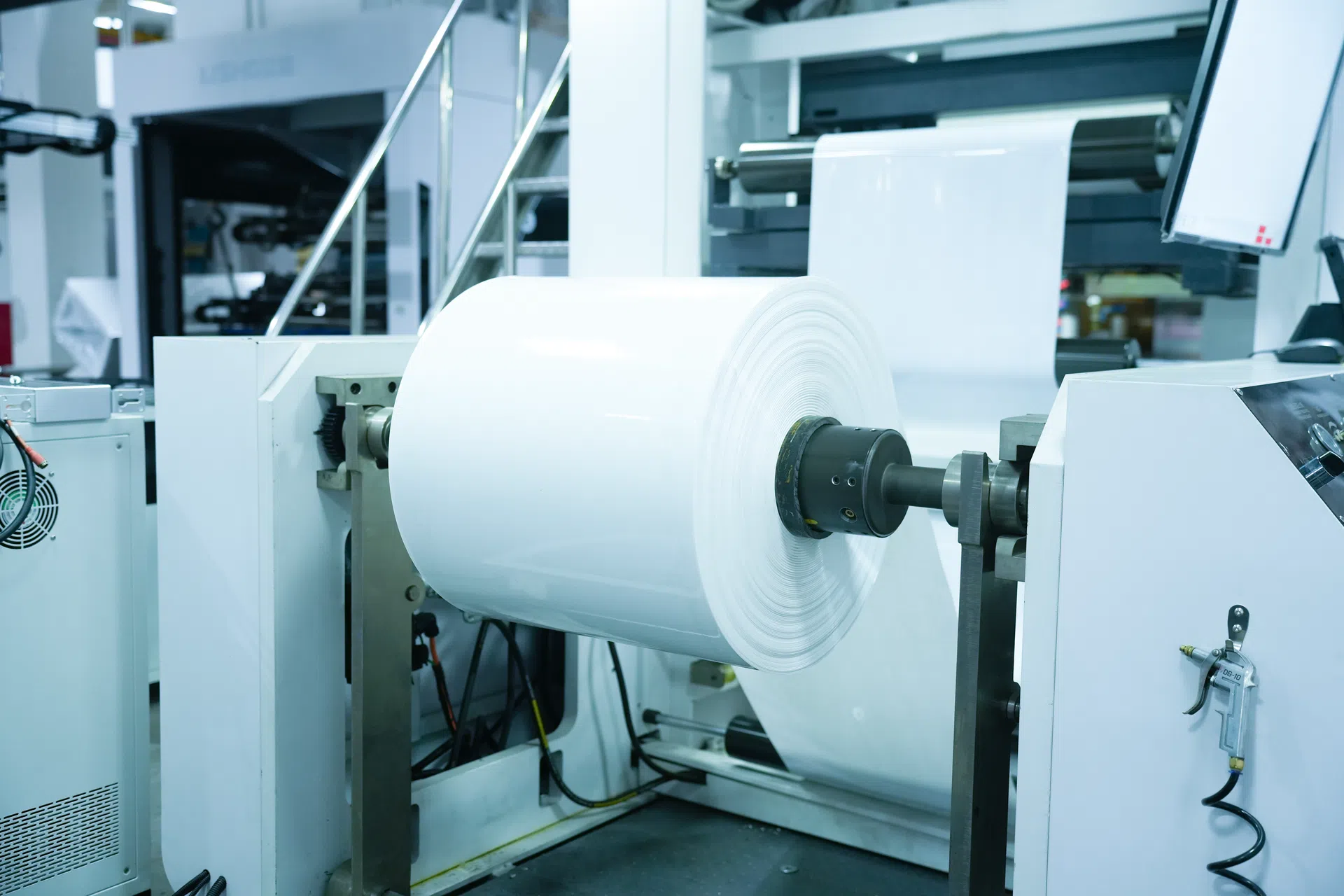
BUYER REFERENCE
Typical CI Flexo Production Parameters
Published machine speed should be read together with substrate, width, color count, ink system, drying configuration and the required quality level. The following reference provides a practical framework for comparing LISHG CI flexo platforms.
Parameter | Typical / Published Range | Buyer Consideration |
|---|---|---|
Maximum mechanical speed | Ultra 150–200 · Apex ≤250 · King up to 350 · Master up to 500 m/min | A mechanical ceiling is not automatically the sustainable production speed. |
Typical usable speed | Application-dependent; King film applications may target around 300 m/min, while Master high-speed film applications may target approximately 400–450 m/min. | Drying, tension and substrate stability must support the selected window. |
Printing width | Catalog range approximately 600–1600 mm; common configurations include 800–1600 mm or custom widths. | Width changes web handling, drying load and machine configuration. |
Colors | Common 4 / 6 / 8 colors; custom configurations available. | More stations mean additional register axes and potentially greater ink load. |
Substrate | PE, BOPP, PET, CPP, laminated films, paper and other web materials depending on configuration. | Gauge, elasticity, surface and heat response determine the real operating window. |
Ink | Solvent-based and water-based applications depending on configuration. | Drying capacity must match ink type, coverage, color count and target speed. |
SPEED LIMIT FOUNDATIONS
What Actually Limits the Usable Speed of a CI Flexo Press?
The usable speed of a CI flexo press is limited by whichever part of the production system first falls outside the required process tolerance. For flexible packaging, drying capacity and substrate stability are often among the most important practical limits, but tension, registration, ink transfer, mechanical rigidity and automation also determine how reliably the press can operate at speed.
01 · SUBSTRATE
Stretch, gauge, surface and heat sensitivity define the working window.
02 · DRYING
Higher speed reduces residence time and increases drying demand.
03 · TENSION
Thin films can stretch, flutter or wrinkle when tension becomes unstable.
04 · REGISTER
Color-to-color accuracy becomes harder to maintain as speed increases.
BUYER CHECKPOINT
Four Questions Buyers Should Answer Before Comparing Speed
01 · WHAT ARE YOU PRINTING?
Substrate & Gauge
Identify the main films, papers or laminated structures and provide actual thickness or gauge data.
02 · HOW MANY COLORS?
Station Count
Define the normal and maximum color count from the artwork. Additional stations add register coordination and ink load.
03 · WHAT INK SYSTEM?
Ink & Drying
Specify solvent-based or water-based ink, approximate coverage and drying requirements.
04 · WHAT QUALITY LEVEL?
Production Tolerance
Define register, density, adhesion and appearance requirements before selecting a speed target.
CORE TECHNOLOGY
What Makes CI Flexo Printing Stable at High Speed?
1. Central Impression Drum
Multiple printing units are arranged around one large central impression drum. The drum provides a shared support reference as the web passes through each printing station, which is especially important for flexible films where web movement can directly affect register and density.
A stable CI geometry helps reduce unnecessary web movement between printing stations and provides a consistent printing reference for multi-color production.
2. Web Tension Control
From unwinding through printing to rewinding, the substrate continuously changes speed and roll diameter. Closed-loop tension control helps keep web movement predictable during acceleration, deceleration, and diameter changes.
When tension becomes unstable, converters may see film stretch, wrinkles, flutter, web breaks or color-to-color register variation. Thin PE and BOPP can be particularly sensitive to excessive or unstable tension.
3. Mechanical Rigidity
As speed increases, the frame, printing units, cylinders, guide rollers and bearings must maintain their position under dynamic load. Mechanical vibration can appear as density variation, impression instability or soft register before the drive system reaches its nominal speed ceiling.
4. Servo Synchronization
Servo systems electronically coordinate printing units and web handling, particularly during acceleration, deceleration, register correction and job changes.
Servo control and gearless construction should not be treated as identical concepts. Servo provides electronic motion control, while gearless architecture removes traditional mechanical gears between printing units. A servo-gear CI press and a full-servo gearless CI press can therefore serve different production requirements.
5. Automatic Register Control
At high speed, small color-to-color deviations can become visible on the finished package. Automatic register systems typically follow a closed-loop process:
DETECT
Read register marks
CALCULATE
Identify deviation
CORRECT
Adjust the relevant unit
VERIFY
Confirm recovery
6. Ink Transfer Control
Stable ink transfer at speed depends on anilox selection, ink viscosity, doctor blade condition, impression settings, ink formulation and substrate surface. Consistent metering and ink circulation help prevent density variation as the press accelerates and runs continuously.
7. Drying System
Drying capacity often becomes one of the most important limits on usable speed in flexible packaging. As web speed increases, dryer residence time decreases. The drying system must therefore remove the required solvent or water within a shorter time.
If drying is insufficient, the converter may encounter blocking, smear, weak adhesion or residual solvent issues before the press reaches its mechanical maximum.
8. Process Automation
Automation coordinates tension, register, servo synchronization, ink management, drying and speed monitoring so that the production process remains repeatable. The objective is not simply a faster motor, but a stable production window that operators can use consistently.
SPEED EVALUATION
Mechanical Speed vs Actual Production Speed
Maximum mechanical speed describes the upper operating envelope of the press under defined conditions. Sustainable production speed is the speed at which dryness, tension, register, density, and substrate stability remain within the required tolerance on the customer's actual job.
Factor | Impact on Usable Speed | Why It Matters |
|---|---|---|
Machine mechanics | Medium to High | Sets the mechanical ceiling and influences vibration. |
Web tension | Very High | Thin film stretch and flutter can directly affect register. |
Registration | Very High | Color-to-color accuracy must remain within customer tolerance. |
Drying capacity | Very High | Residence time falls as web speed increases. |
Ink/coverage/colors | High | Higher ink load can increase drying demand. |
Substrate | Very High | Gauge, elasticity and heat response define the practical window. |
Buyer question: At what speed can the press hold quality and register on your actual film, paper or laminated web—not simply what is the maximum number on the specification sheet?
PRODUCTION SPEED BENCHMARK
250 vs 350 vs 500 m/min: What Is the Real Production Speed?
Brochure speed bands are useful for initial screening, but real production speed is the speed that can be maintained with drying, tension, register, and density inside the required quality window.
Target Band | Typical Limiter | LISHG Platform Reference | Buyer Interpretation |
|---|---|---|---|
~250 m/min | Drying, register and web stability on higher-speed jobs | Apex Series ≤250 m/min | A practical step-up from mid-speed CI production. |
~350 m/min | Drying + tension + register must be sized for the job | King Series up to 350 m/min; around 300 m/min may be the practical film production target | High-volume film production when the complete configuration supports the target window. |
~500 m/min | Drying, substrate stability, tension and process repeatability | Master Series up to 500 m/min | A high-speed platform for applications where the complete production system can support the required usable window. |
The important distinction is that a 350 m/min mechanical envelope does not mean every job should run at 350 m/min, just as a 500 m/min machine does not mean every job will be commercially productive at 500 m/min.
TROUBLESHOOTING GUIDE
High-Speed Problems → Cause → CI Flexo Solution
When high-speed CI flexo printing becomes unstable, the symptom is rarely simply “the machine is too slow.” Buyers should identify the process cause and then determine which machine system addresses it.
Problem | Typical Cause | Relevant CI Flexo Solution |
|---|---|---|
Register drift | Web tension variation or thin-film stretching | Closed-loop tension + CI drum support + automatic register |
Color variation | Ink viscosity or metering drift | Stable ink circulation + chamber metering |
Film flutter/wrinkles | Unstable web dynamics | Web handling + tension control + CI support |
Blocking/smear | Insufficient drying at selected speed | Drying capacity matched to ink, coverage, colors and usable speed |
Vibration/density bounce | Mechanical resonance under dynamic load | Rigid machine structure + balanced rotating components |
Register lag during acceleration | Units and web path lose synchronization | Servo synchronization + automatic register loop |
SUBSTRATE ANALYSIS
Why Substrate Matters at High Speed
Listing film names alone does not explain high-speed behavior. What matters is the physical chain: substrate → characteristic → printing challenge → machine response → usable result.
Substrate | Physical Characteristic | Challenge at Speed | Machine Response | Usable Result |
|---|---|---|---|---|
Thin PE | Low modulus; stretches under tension changes | Register drift, wrinkles and flutter | Closed-loop tension + CI support + automatic register | Stable multi-color printing within the required speed window |
Thin BOPP | Oriented film; sensitive to over-tension and heat | Web distortion, density variation and drying-related issues | Precise tension + CI support + matched drying | Stable register and dryness without unnecessarily reducing speed |
PET | Stiffer than PE but still heat-sensitive | Drying, adhesion and synchronization requirements | Servo synchronization + register + matched drying | Stable high-speed printing when dryer and drive package match the job |
CPP / Laminates | Gauge and surface properties vary | Ink wetting, density and web-path behavior | Ink metering + tension zoning + CI support | Consistent density and register at a job-matched speed |
Paper / Kraft | Higher stiffness and absorbent surface | Ink absorption, drying and set-off | Ink volume control + matched drying | Speed limited more by ink and drying than film stretch in many jobs |
COLOR COUNT
How Color Count Can Affect the Usable Speed of a CI Flexo Press
Color count should be considered together with ink coverage, drying capacity, and register requirements. More colors do not automatically mean lower production speed, but additional printing stations increase the number of register relationships and may increase the total ink load.

4 COLORS
Lower Station Load
A four-color job may create a lower overall register and drying load when artwork and coverage are comparable.
6 COLORS
Higher Coordination
Six-color production adds register relationships and may increase total ink load, making drying and synchronization more important.
8 COLORS
Complete System Matching
Eight-color jobs require careful coordination of register, ink transfer, web handling and drying at the selected production speed.
CUSTOM
Application-Specific
Custom station counts and configurations should be evaluated from actual artwork, substrate, ink and target production speed.
PRODUCTION ECONOMICS
Usable Speed Is Not the Same as Actual Production Output
Machine speed alone does not determine daily production output. A press running at a higher speed may deliver less useful production if startup waste, changeover time, cleaning, register adjustment or quality rejection is high.
Startup Waste
Material lost before stable production.
Changeover Time
Time between jobs reduces effective output.
Quality Rejection
Fast production is not useful if quality is outside tolerance.
Downtime
Stops and adjustments reduce actual production hours.
PRODUCTION PRINCIPLE
Sustainable speed × uptime × acceptable quality can be more commercially important than maximum mechanical speed alone.
LISHG ENGINEERING APPROACH
How LISHG Applies These Technologies
LISHG CI flexographic printing machines integrate mechanical, drive, printing, drying and control systems according to different production requirements. The correct configuration starts from the customer's production profile rather than from a maximum speed number alone.
Technology | Machine System | Production Benefit |
|---|---|---|
Central impression | CI impression drum | Stable web support through multiple printing stations |
Tension control | Unwinding and rewinding system | Predictable substrate movement |
Servo synchronization | Servo drive system | Precise motion coordination |
Automatic register | Register control system | Consistent color-to-color registration |
Ink management | Ink circulation and metering | Stable ink transfer and density |
Drying | Job-matched drying system | Supports the required usable production speed |
Process automation | Central control system | Repeatable production conditions |
MACHINE SELECTION
Which LISHG CI Flexo Platform Fits Your Speed Requirement?
Select the machine platform from the production process, not simply the highest brochure number. The speed envelope should be matched to substrate behavior, drying requirements, color count, register tolerance and expected production output.
150–200 M/MIN CLASS
Ultra Series
A balanced CI platform for converters requiring stable mid-speed production across film and paper applications. It is suitable when the required production window is within the 150–200 m/min class and investment balance is important.
UP TO 250 M/MIN CLASS
Apex Series
A servo gear CI platform for higher-speed packaging production around the 250 m/min class. It provides a step-up in automation and production capability without automatically moving to the flagship gearless platform.
UP TO 350 M/MIN CLASS
King Series
A high-volume CI platform positioned around the 300–350 m/min production envelope. For film applications, around 300 m/min may be the practical production target depending on substrate, ink, drying, and quality requirements.
UP TO 500 M/MIN CLASS
Master Series
LISHG's flagship full-servo gearless CI platform for demanding high-speed production. A 500 m/min mechanical ceiling does not mean every job should run at 500 m/min; high-speed film applications may require a lower but sustainable operating window such as approximately 400–450 m/min.
PRODUCTION VALIDATION
Why a Production Test Is More Valuable Than a Speed Claim
For a serious equipment investment, the most useful way to validate CI flexo press speed is to evaluate the machine against the customer's actual production conditions.
YOUR SUBSTRATE
Actual Material
Provide the actual film, paper or laminate and its measured gauge or thickness.
YOUR ARTWORK
Representative Job
Representative artwork gives a more realistic indication of ink coverage and register requirements.
YOUR INK
Real Ink System
Ink type, viscosity, coverage and drying characteristics should be considered during evaluation.
YOUR TARGET SPEED
Usable m/min
Define the speed that must be sustained during commercial production, not only the desired maximum.
The objective: determine whether the proposed machine can maintain the required print quality, register, drying and web stability continuously at the target production speed.
PROCUREMENT GUIDE
How to Choose a CI Flexo Printing Machine
Before requesting a quotation, prepare the following production information. A complete production profile allows the machine supplier to evaluate the speed envelope and identify the first likely process limiter.
RFQ Parameter | Information to Provide | Why It Matters |
|---|---|---|
Substrate | Primary web, material structure and actual behavior at speed | Determines tension, drying and web stability requirements |
Material thickness | Measured film μm or paper GSM | Thickness influences web handling and drying assumptions |
Printing width | Required width and production range | Width influences web handling and configuration |
Number of colors | 4 / 6 / 8 or custom station count | Additional stations increase register coordination and ink load |
Ink type | Solvent-based or water-based, plus coverage | Drying capacity must match the production job |
Required speed | Target usable m/min on the named substrate | Separates commercial speed from mechanical maximum |
Future production | Expected changes in substrate, products, width and volume | Allows sufficient technical headroom for future growth |
SUPPLIER EVALUATION
Why Work With LISHG?
A CI flexo press purchase is a production decision. The machine platform should be matched to the customer's substrate, speed, color count, drying requirements and expected operating conditions.
Decision Input | What Should Be Evaluated |
|---|---|
Substrate | Stretch, heat, absorbency and gauge behavior rather than material name alone |
Printing width | Width range matched to web handling, drying and plant requirements |
Colors | Station count based on artwork and associated register and drying load |
Target usable speed | Platform envelope matched after substrate and drying limitations are considered |
Tension & register | Closed-loop web handling and automatic register requirements |
Ink & drying | Drying package sized to ink, coverage, colors and usable speed |
Automation & growth | Automation and configuration headroom based on today's jobs and expected future production |
PRODUCTION MATCHING
Machine selection starts from substrate, speed, and application requirements.
CONFIGURATION REVIEW
Width, colors, drying, tension and register are evaluated as an integrated system.
FACTORY CAPABILITY
Factory testing and production trials can help validate the configuration before shipment.
EXPORT SUPPORT
Technical documentation, FAT, installation guidance and overseas commissioning support are part of the equipment purchasing process.
FREQUENTLY ASKED QUESTIONS
CI Flexo Press Usable Speed FAQ
What is usable speed on a CI flexo press?
Usable speed is the highest production speed at which the CI flexo press can continuously maintain the required print quality, register, drying, ink transfer, and web stability for a specific production job.
What is the difference between maximum speed and usable production speed?
Maximum speed describes the upper machine capability under specified conditions. Usable production speed is the speed that can be sustained while meeting the customer's actual quality and process requirements.
What usually limits CI flexo press speed?
Drying capacity, substrate stability, web tension, register, ink transfer and mechanical dynamics are common limiting factors. The first factor that falls outside the required tolerance can define the usable speed.
Why can a CI flexo press have a 500 m/min maximum speed but run slower in production?
A 500 m/min machine may have the mechanical capability to reach that speed, but a specific job may be limited by substrate stability, drying capacity, ink coverage, register requirements or other production conditions.
Does more printing color reduce usable speed?
Not automatically. More colors can increase total ink load and registration requirements, but the actual effect depends on ink coverage, substrate, drying capacity, artwork and machine configuration.
How does substrate thickness affect CI flexo speed?
Thickness affects web behavior and tension response. Thin films can be more sensitive to stretching, flutter and tension changes, while the actual usable speed also depends on substrate properties, width, machine configuration and production requirements.
Is a gearless CI flexo press always faster in real production?
Not necessarily. Gearless drive technology can provide important advantages in motion control and register performance, but actual production speed still depends on drying, substrate, tension, ink, artwork and the complete machine configuration.
How should I specify speed when requesting a CI flexo press quotation?
Provide the supplier with your substrate, thickness, printing width, number of colors, ink system, approximate coverage, required quality level and target usable speed. This gives the supplier a better basis for recommending the machine configuration.
REQUEST A CONFIGURATION
Get a CI Flexo Machine Configuration Based on Your Usable Speed
The right CI flexographic printing machine starts with your production requirements—not simply the machine model or maximum speed. Share your actual production profile so the press configuration can be matched to the real speed limiter.
Substrate
Film, paper or laminate
Thickness
Actual μm or GSM
Width
Required printing width
Colors
4 / 6 / 8 or custom
Ink
Ink type and coverage
Usable Speed
Target m/min
CONCLUSION
The Best CI Flexo Press Is the One That Sustains the Required Production Speed
The usable speed of a CI flexo press is not determined by a single number on a specification sheet. It is the result of how the complete printing system performs under real production conditions.
Substrate stability, drying capacity, web tension, register control, ink transfer, mechanical rigidity, automation and production requirements all contribute to the final operating window.
LISHG's CI flexo portfolio covers different production requirements, from the Ultra Series in the 150–200 m/min class and the Apex Series around the 250 m/min class to the King Series up to the 350 m/min class and the Master Series up to the 500 m/min class.
These speed figures should be treated as machine capability envelopes. The actual production target must be matched to the substrate, width, thickness, color count, ink, drying capacity, and required print quality.
Final buyer principle: choose the CI flexo press that can sustainably deliver the required quality and output on your actual jobs—not simply the machine with the highest advertised maximum speed.
INQUIRY
Connect With LISHG Specialists
Get specifications, performance data or a custom CI flexo configuration based on your substrate, production speed, color count and application.
Request a Quote →

