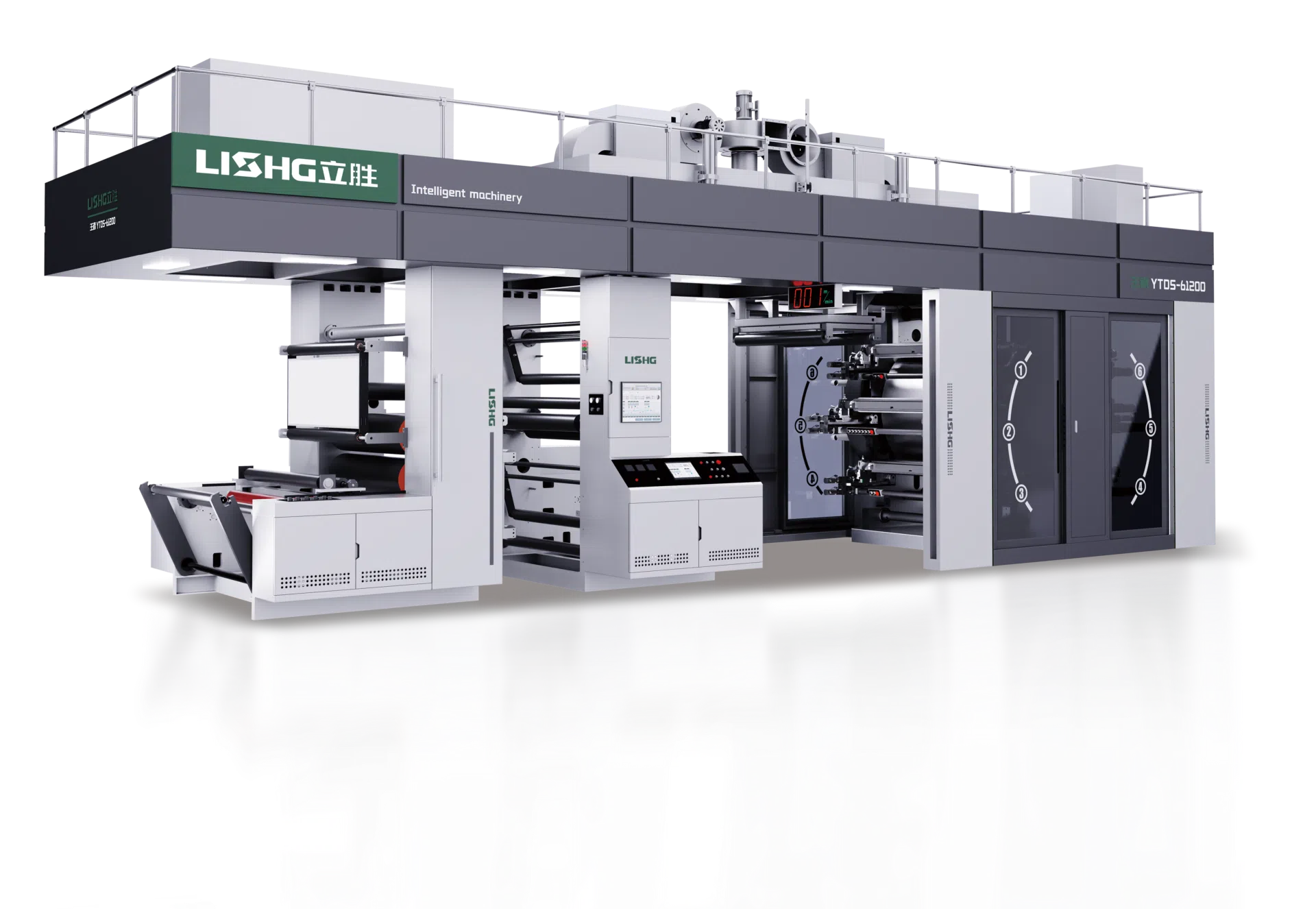
Written by: LISHG Technical Team · Reviewed by: Flexographic Printing Engineering Team · Last updated: August 2026
At a Glance — Short Answer
Short Answer
CI flexo printing machines achieve stable high-speed printing through eight integrated systems — central impression drum, closed-loop web tension, rigid frame, servo synchronization, automatic register, controlled ink transfer, drying capacity matched to the job, and process automation — so quality and registration hold at a commercially usable production speed. Based on LISHG production experience, the practical speed of a CI flexo press is usually determined by drying and substrate stability before the nominal mechanical speed becomes the limiting factor.
The eight systems at a glance:
| # | System | Role at high speed |
|---|---|---|
| 1 | Central impression drum | Stable web support during multi-color printing |
| 2 | Web tension control | Predictable substrate movement unwind → rewind |
| 3 | Mechanical rigidity | Less vibration under dynamic load |
| 4 | Servo synchronization | Precise motion between units and web path |
| 5 | Automatic registration | Detect → calculate → correct → verify |
| 6 | Ink transfer control | Stable density and metering at speed |
| 7 | Drying system | Often the real ceiling on usable speed |
| 8 | Process automation | Repeatable coordination across the press |
The key is not simply the maximum mechanical speed of the press. A production-ready CI flexo machine must maintain stable web handling, accurate color registration, consistent ink transfer, and sufficient drying at the required production speed.
Stable high-speed CI flexo printing is not one “fast motor.” The sections below cover the systems that hold quality at speed, how mechanical max differs from usable production speed, and what that means on real film jobs — with published parameters and a first-party case where useful.
At a glance · Parameters · Eight systems · Running video · Max vs usable · 250 / 350 / 500 · Problem → solution · Substrate → solution · Case study · How to choose · FAQ · Request config
Typical CI Flexo Production Parameters
Figures follow published LISHG catalog ranges across Ultra, Apex, King and Master (full-servo gearless). Dryer zone layout is sized per RFQ.
| Parameter | Example / catalog range |
|---|---|
| Max mechanical speed | Ultra ≈150–200 · Apex ≤250 · King 350 m/min · Master 500 m/min |
| Typical / recommended production speed | King film application matrix: ~300 m/min recommended on BOPP / PET / PE food & snack constructions (max 350). Master film: recommended printing 400–450 m/min (mechanical ceiling 500) |
| Commercial matching baseline | Film (BOPP / PET / PE) · width 1000–1300 mm · target ~350 m/min → King (≤350 envelope) |
| Printing width | Catalog band 600–1600 mm · common options 800 / 1000 / 1200 / 1300 / 1400 / 1600 mm or Custom (King example page: 1200 mm print width class) |
| Colors | Common builds 4 / 6 / 8 (also 2 / 10 / Custom). More colors = more stations in the CI arc → more register axes to hold and more ink load for the dryer at the same m/min |
| Register accuracy | King product page: ±0.08–0.10 mm · Master film: ±0.08 mm class · PawPack case-measured: ±0.08 mm on food-film constructions — project conditions apply |
| Substrate / thickness | Stretchy thin PE/BOPP stress tension + register; PET is stiffer but still needs stable web path; CPP varies by gauge. King film thickness range 8–250 μm (material-dependent) · food-film matrix often 10–120 μm |
| Ink | Solvent-based / water-based (and UV where specified) — dryer capacity must match ink + coverage + usable m/min |
| Drying | Job-matched controlled drying (often the first ceiling on usable speed). Zone layout sized per RFQ for each series and job |
| Drive | Ultra mid-speed CI · Apex servo-gear CI · King high-volume CI · Master full-servo gearless (separate Gearless line) |
| Unwinding / rewinding diameter | King film published: maximum roll diameter Ø800 mm · servo-driven active unwinder / rewinder · non-stop splice options available on configured lines |
LISHG experience note: Based on LISHG production experience, the practical speed of a CI flexo press is usually determined by drying and substrate stability before the nominal mechanical speed becomes the limiting factor. Film · 1000–1300 mm · ~350 m/min maps to King; a 400–450 m/min recommended printing window belongs on Master — and only when dryer + tension are sized for that usable band.
What Makes CI Flexo Printing Stable at High Speed?
1. Central Impression Drum
Multiple printing units sit around one large central impression drum. The drum is the shared reference as the web moves through each station — especially useful on flexible film where web support reduces movement that hurts register and density.
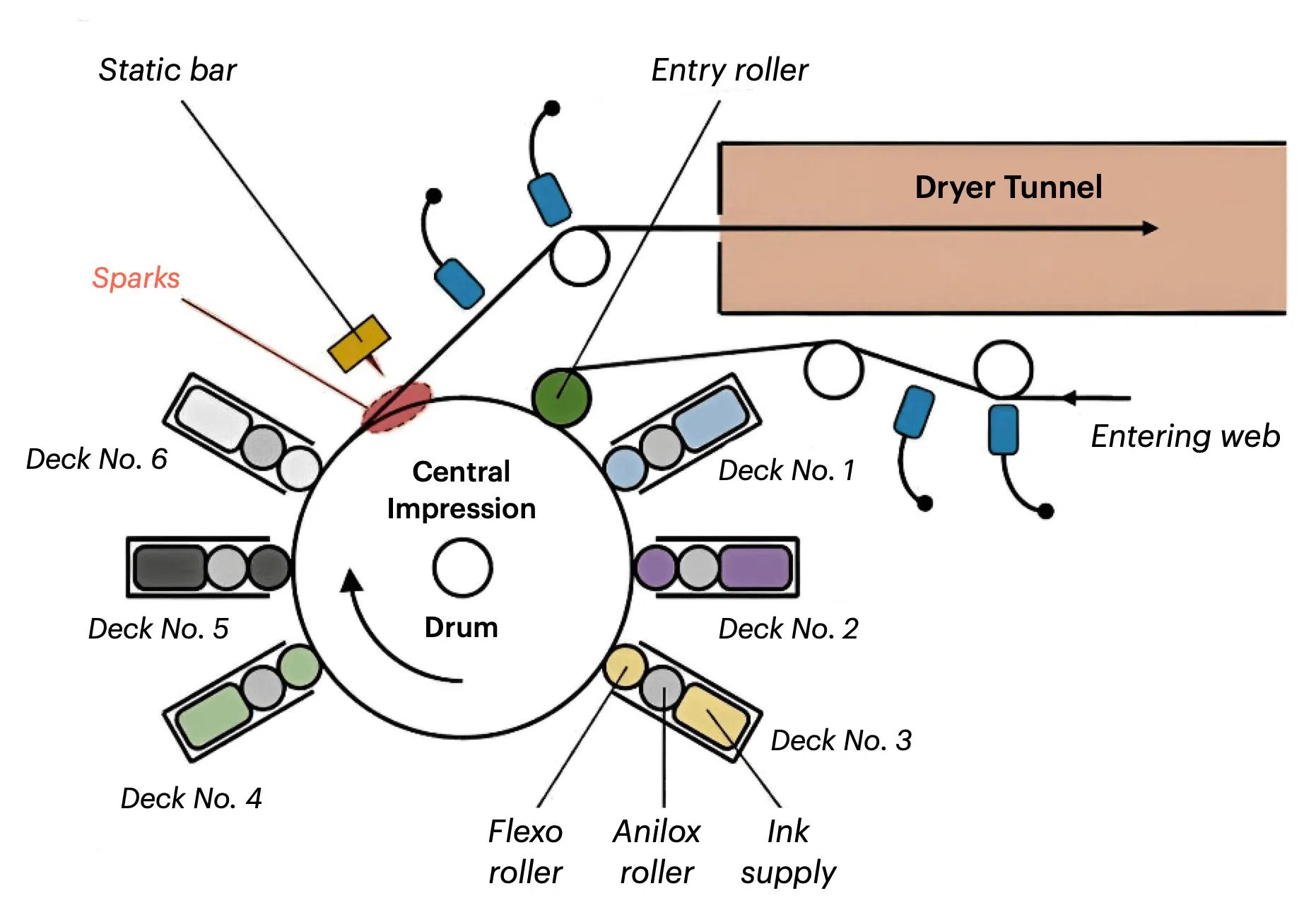
CI working principle — shared central impression drum
2. Web Tension Control
From unwinding through printing to rewinding, the substrate continuously changes speed and roll diameter. Closed-loop tension keeps that movement predictable at high speed.
When tension drifts, converters typically see color-to-color register variation, film stretch, wrinkles or web flutter, web breaks, and inconsistent density.
A typical high-speed film chain looks like this: thin PE → low modulus / stretch risk → tension fluctuation under accel and diameter change → register deviation between colors → closed-loop tension (plus CI drum support) → usable speed without chasing register by hand.
A properly configured tension system keeps the web path predictable unwind → print → rewind under acceleration and diameter change.
3. Mechanical Rigidity
As speed rises, the frame, print units, cylinders, guide rollers and bearings must hold position under dynamic load. Vibration shows up as density bounce and soft register before the drive hits its ceiling.
A rigid cast structure with balanced rotating parts lowers vibration, steadies impression pressure, and supports stable registration through multi-shift production.
4. Servo Synchronization
Servo drives electronically synchronize print units and web handling — especially during acceleration, deceleration, register correction and job changes. That precise motion response helps keep units and the web path locked together at production speed.
Servo drive and gearless construction are related but not the same: servo provides electronic motion control; gearless removes traditional mechanical gears between units. A press can use servo drives with a geared CI architecture, or run a full-servo gearless platform when register response, changeover and usable speed justify that drive design.
5. Automatic Register Control
At high speed, small register deviations show on the finished pack. Closed-loop register typically runs: Detection → Calculation → Correction → Verification.
| Detection | Calculation | Correction | Verification |
Sensors or cameras read marks; the unit adjusts automatically. Published register figures must be read with substrate, speed and test conditions.
6. Ink Transfer Control
Stable transfer at speed depends on anilox, viscosity, doctor blade, impression, ink formula and substrate. Circulation and chamber metering keep density from drifting as the press accelerates.
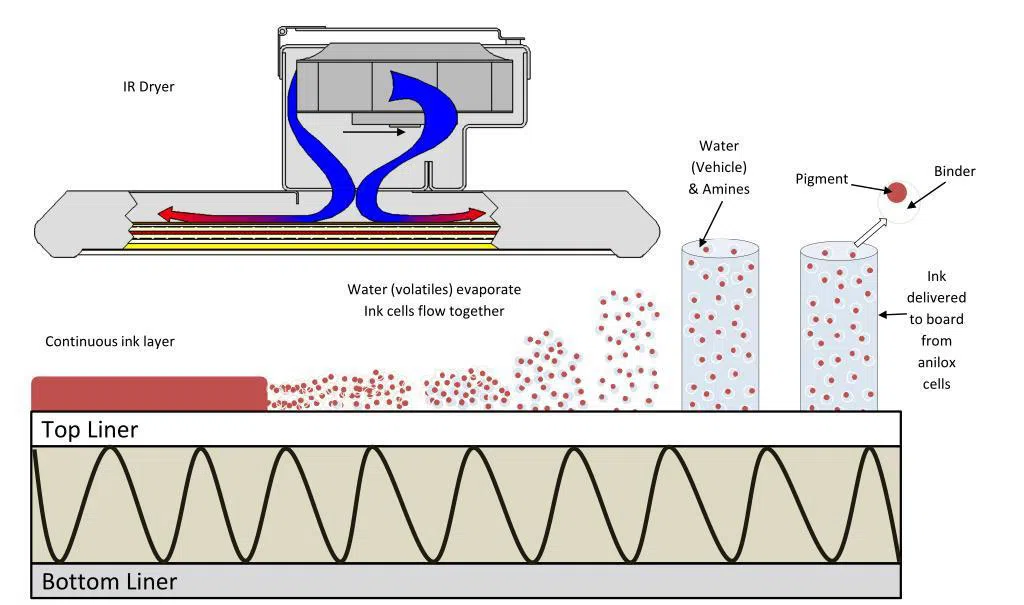
7. Drying System
Drying capacity often sets usable speed on flexible packaging. Faster web = less residence time. Undersized drying shows as blocking, smear or weak adhesion before the mechanical max is reached.
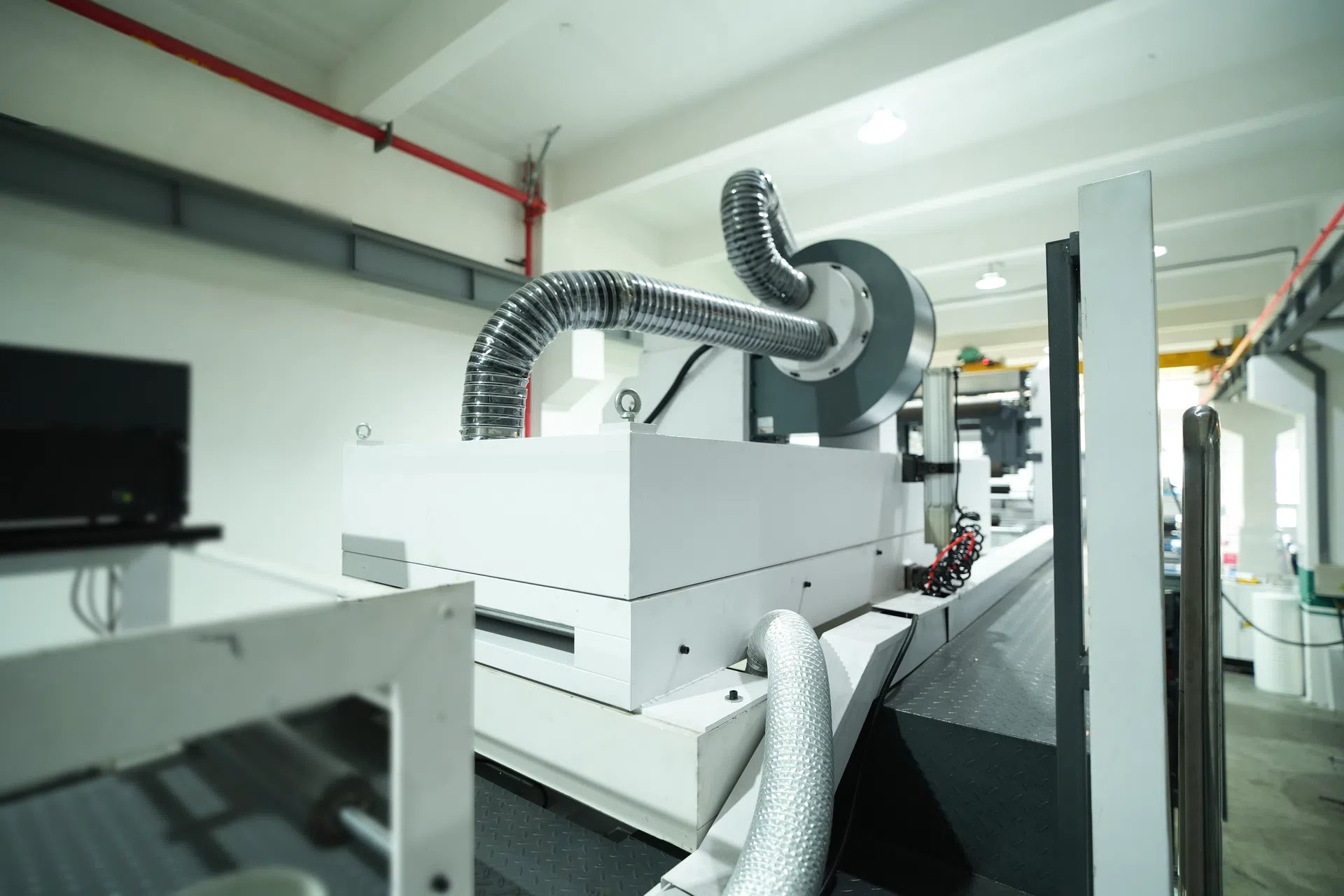
Dryer photo |
Dryer principle |
Dryer demand by usable speed class
As usable m/min rises, dryer residence time falls. A mid-speed film line (≈150–250) usually tolerates a lighter dryer package than a ~300–350 production band; a 400–450 usable window needs drying and tension sized together — drive architecture alone does not buy dryness.
| Usable speed class | Typical envelope | Drive note | Drying implication |
|---|---|---|---|
| Mid-speed CI | ≈150–200 m/min | Geared / servo-gear CI | Longer residence — easier solvent / water finish |
| High-speed CI step-up | ≤250 m/min | Servo-gear CI | Dryer sized for 250-class jobs |
| High-volume film band | ≤350 · often ~300 usable | High-volume CI | Common film production band when drying + tension match |
| Flagship usable window | ≤500 · often 400–450 usable | Full-servo gearless | Shortest residence — dryer package must match the usable window |
Film · 1000–1300 · ~350 → high-volume envelope; usable >350 / 400–450 → only with drying + tension sized together for that window.
8. Process Automation
Automation coordinates tension, register, servo sync, ink, drying and speed monitoring so quality stays repeatable — the goal is usable production speed, not a faster empty motor.
Watch a LISHG CI Flexo Press Running at Production Speed
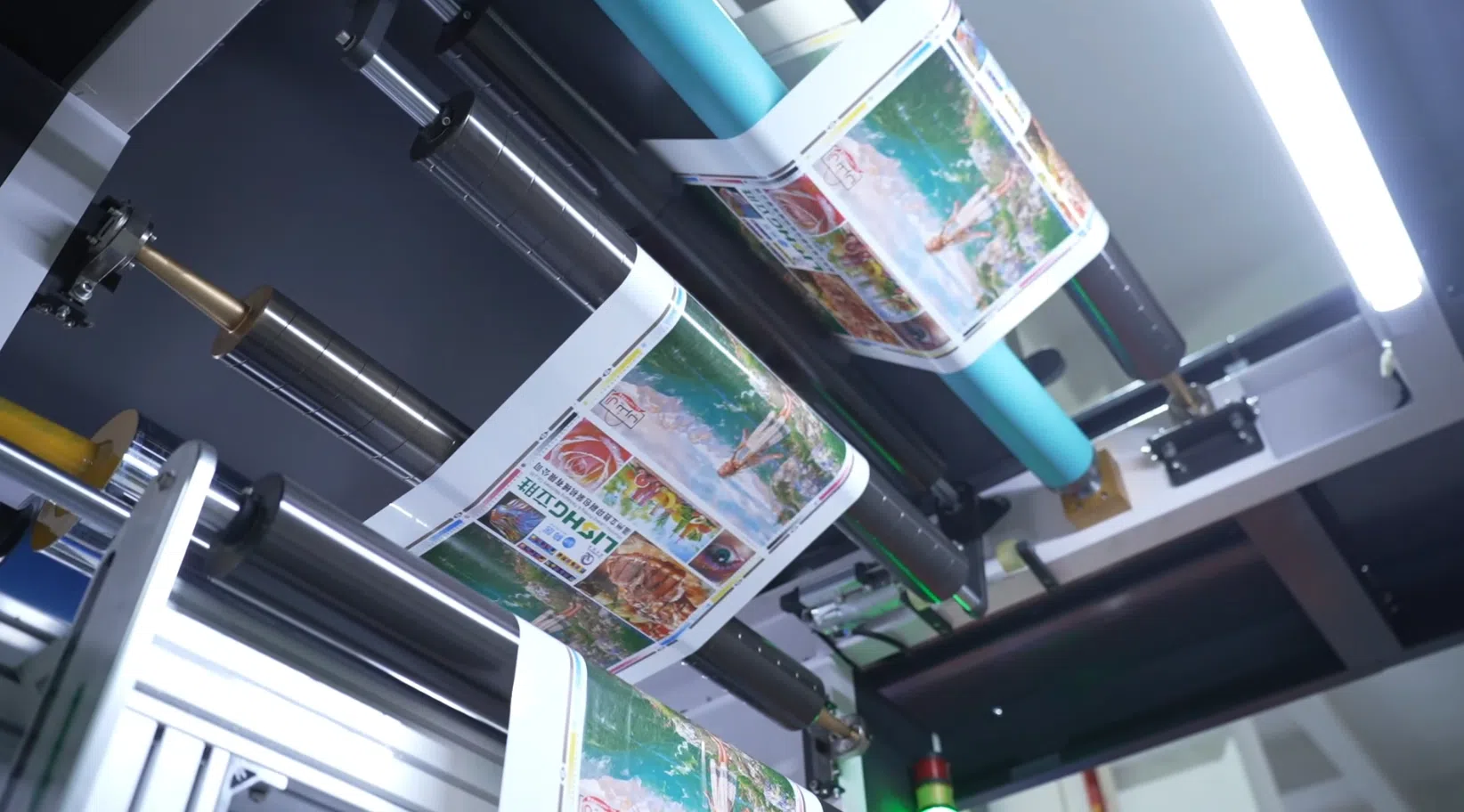
After the eight systems above, the fastest way to judge stable high-speed printing is to watch the press run. This first-hand factory / production video shows a LISHG CI flexographic printing machine in operation — web path, print units around the central impression drum, ink metering, register hold, drying and rewind — so you can see how tension, servo sync and drying work together at usable production speed, not only on a nameplate.
What to look for: steady web handling through unwind → print → dry → rewind; color units tracking together without visible flutter; and drying capacity keeping up as the web moves — the same factors that usually set usable m/min before mechanical max.
LISHG CI flexo press running video · Open on YouTube · Video Center
Mechanical Speed vs. Actual Production Speed
Maximum mechanical speed is the envelope. Sustainable production speed is the m/min where dryness, tension, register and density stay inside tolerance on your job.
| Factor | Impact on usable speed | Why it matters |
|---|---|---|
| Machine mechanics | Medium | Sets the ceiling — rarely the first limiter on film |
| Web tension | Very High | Thin film stretch and flutter |
| Registration | Very High | Color-to-color hold at speed |
| Drying capacity | Very High | Residence time falls as m/min rises |
| Ink / coverage / colors | High | More ink load = more dryer demand |
| Substrate | Very High | Gauge and stretch set the real window |
Ask: “At what speed can this press hold quality and register on my film?” — not only “What is the maximum speed?”
250 vs 350 vs 500 m/min: What Is the Real Production Speed?
Brochure bands are envelopes. Real production speed is the m/min you can hold with dryness, tension, register and density inside tolerance for your job mix. Below is how engineers typically read three common targets — then what catalog ceiling usually belongs with each.
| Target band | What usually limits usable speed | LISHG catalog envelope |
|---|---|---|
| ~250 m/min | Often CAPEX-balanced film work; do not force a 350 target into a ≤250 platform | Apex ≤250 (Ultra covers lower mid-speed) |
| ~350 m/min | Drying + tension must match; a ~300 usable day still sits under a ≤350 ceiling | King ≤350 — common film baseline · 1000–1300 · ~350 |
| ~500 m/min | Justify only if job mix + dryer + substrate stability can support that usable window | Master ≤500 — required when target >350 and drying/tension can hold it |
Engineering profile: ~300–350 usable vs 400–500 claim
Same film-job family, two capability levels. A full-servo gearless platform is not simply “a faster high-volume CI” — dryer and web handling must scale with the usable window.
| Field | Profile A — production-ready ~300–350 | Profile B — high-speed claim 400–500 |
|---|---|---|
| Substrate | BOPP / PET / PE (food & snack matrix) | PE / PET / BOPP / laminated webs |
| Thickness band | Matrix 10–120 μm (King film range 8–250 μm) — thin BOPP ~20 μm sits inside this band | Same film family — tension + dryer must hold at higher usable speed |
| Width | 1000–1300 mm commercial baseline (catalog options include 1000 / 1200 mm) | Same width class — platform escalates for speed, not width alone |
| Colors | 6 / 8 typical flexible-packaging builds | 6 / 8 Master film platforms |
| Ink | Water-based / solvent (matrix) | Same ink families — dryer load rises with usable m/min |
| Target / published speed | Recommended ~300 m/min · mechanical max 350 | Recommended printing 400–450 m/min · mechanical 500 |
| Register | King product page ±0.08–0.10 mm | Master film ±0.08 mm class |
| Unwind / rewind | Active servo · max roll Ø800 mm (King published) | Full-servo gearless flagship web path + dryer package (RFQ) |
| Result / platform | King — production-ready when drying + tension match the ~300–350 usable window | Master — only when dryer + substrate stability can support 400–450 usable (not nameplate 500 alone) |
LISHG engineering read: Profile A maps to King when drying + tension hold the ~300–350 usable window. Profile B needs a full-servo gearless platform and a dryer / web-handling package sized for 400–450 usable — not nameplate 500 alone.
High-Speed Problems → Cause → CI Flexo Solution
When high-speed CI flexo is unstable, the symptom is rarely “the motor is slow.” Map the symptom to the process cause, then to the machine system that addresses it.
| Problem | Typical cause | CI flexo solution |
|---|---|---|
| Register drift | Web tension / stretch on thin film | Closed-loop tension + CI drum geometry + automatic register |
| Color variation | Ink viscosity / metering drift at speed | Ink circulation + chamber doctor blade metering |
| Film flutter / wrinkles | Air / web dynamics; unstable unwind–print–rewind path | Web handling + tension control around CI drum |
| Blocking / smear | Insufficient drying at the chosen speed | Dryer capacity matched to ink, coverage, colors and usable m/min |
| Vibration / density bounce | Mechanical resonance under dynamic load | Rigid cast frame + balanced rotating components |
| Register lag on accel / job change | Units and web path out of sync during speed change | Servo synchronization + detect→calculate→correct→verify register loop |
Why Substrate Matters at High Speed
Listing film names does not explain high-speed behavior. What matters is the physical chain: substrate → characteristic → printing challenge → machine response → usable result. The same CI geometry can look “stable” or “unstable” depending on that chain.
| Substrate | Physical characteristic | Printing challenge at speed | Machine response | Usable result |
|---|---|---|---|---|
| Thin PE | Low modulus — stretches under tension change | Tension fluctuation → color-to-color register drift; wrinkles / flutter | Closed-loop tension + CI drum support + auto register | Stable multi-color printing at commercially usable m/min |
| Thin BOPP | Oriented film — low gauge, sensitive to over-tension and heat | Web distortion, density bounce, dryer-driven curl / blocking if residence time is short | Precise tension window + CI support + dryer capacity matched to ink / coverage | Hold register and dryness without lowering speed to “safe empty” m/min |
| PET | Higher stiffness than PE — less stretch, still heat-sensitive in dryer | Less elongation error, but smear / adhesion fail if drying lags; register still drifts if units desync on accel | Servo sync + auto register + dryer sized to usable speed (not only tension) | Stiffer web still needs a matched dryer / drive package for high usable m/min |
| CPP / laminates | Gauge and surface energy vary; laminates add curl / slip behavior | Ink wetting / density drift; web path less predictable across layers | Ink metering stability + tension zoning + CI support through print stations | Consistent density and register when the job, not the brochure, drives setup |
| Paper / kraft | Higher stiffness, porous / absorbent surface | Less stretch risk; more ink absorption and drying / set-off concerns | Ink volume control + dryer matched to coverage (tension still needed, but film stretch is not the first limiter) | Usable speed limited more by ink/dry than by elongation |
| Non-woven / woven | Open structure, variable thickness, lower surface uniformity | Impression / density variation; dust and web handling noise | Rigid CI impression geometry + stable ink metering; speed targets often lower than thin-film food packs | Acceptable quality at a usable speed sized for the substrate — not a film nameplate copied over |
Worked example — thin PE: stretch risk → tension fluctuation → register deviation → closed-loop tension (+ CI drum + auto register) → stable high-speed printing. That chain is why “PE” appears in film RFQs — not because the acronym itself is a keyword.
Color count follows the same logic
Moving from 4 to 6 or 8 colors is not only “more branding.” Each added station adds another register axis around the CI drum and more ink for the dryer to finish in less residence time. Choose color count from artwork and brand needs, then size tension, register and drying for that station count at the target usable m/min.
How LISHG Applies These Technologies
LISHG CI flexographic printing machines integrate mechanical, drive, printing, drying, and control systems according to different production requirements.
| Technology | Machine system | Production benefit |
|---|---|---|
| Central impression | CI impression drum | Stable web support |
| Tension control | Unwinding and rewinding system | Stable substrate movement |
| Servo synchronization | Servo drive system | Precise motion control |
| Automatic register | Register-control system | Consistent color registration |
| Ink management | Ink circulation and metering | Stable ink transfer |
| Drying | Drying system | Improved usable production speed |
| Process automation | Central control system | Repeatable production |
The appropriate configuration follows the job’s causal chain — how the substrate behaves, how many stations must register, how much ink the dryer must finish — then width and automation are sized around that usable window.
Matching Configuration to the Application
Select from the production process, not the highest brochure number. Use the substrate chain above, then ask which systems must be sized together for your usable m/min.
| Job pattern | What usually fails first | What to size together |
|---|---|---|
| Thin stretchy film (PE / thin BOPP) | Register and wrinkles from tension drift | Closed-loop tension + CI support + auto register |
| High usable m/min on film | Blocking / smear when dryer residence time collapses | Dryer capacity + tension + ink coverage as one package |
| More print stations (e.g. 6 → 8) | Extra register axes + higher ink load for the same web speed | Servo sync + auto register + dryer headroom for the station count |
| Shelf-critical register | Color lag on accel / job change | Servo synchronization + closed-loop register (detect → correct → verify) |
| Long runs / frequent changeover | Waste and downtime erase nameplate speed | Usable speed envelope + automation that keeps quality repeatable |
Catalog mechanical envelopes typically span ≈150–200 · ≤250 · ~300–350 · up to 500 m/min. Match the envelope to usable m/min after the substrate chain and dryer limits — not the other way around.
Published Speed Envelopes (LISHG Reference)
If you need a concrete catalog mapping after the engineering criteria above, these are published LISHG CI platforms by mechanical / recommended usable class. Treat them as envelopes — width, colors, drying and automation still decide the RFQ.
| Platform | Catalog speed | Drive | Typical use |
|---|---|---|---|
| Ultra | 150–200 m/min | Mid-speed CI | Balanced CAPEX film / paper at mid-speed |
| Apex | ≤250 m/min | Servo-gear CI | Step-up automation without full gearless CAPEX |
| King | 300–350 (film often ~300 usable) | High-volume CI | Common film production band before gearless |
| Master | ≤500 (often 400–450 usable) | Full-servo gearless | Only when dryer + tension justify that usable window |
Case Study: 8-Color CI Flexo on BOPP / PET / PE (PawPack)
First-party customer project — Thailand pet food & pet care packaging. Press: King Series 8-Color High Performance CI Flexo. Full narrative: PawPack case study.
Published case KPIs below. Speed class uses the King ≤350 envelope + film matrix (~300 recommended).
| Field | Published project fact |
|---|---|
| Customer / location | PawPack Packaging Co., Ltd. · Thailand |
| Application | Pet food & pet care bags / pouches · high SKU mix |
| Substrate | BOPP / PET / PE laminate constructions — validated on customer materials |
| Colors / press | 8-color · King Series High Performance CI |
| Speed class (platform) | King envelope ≤350 m/min · film matrix recommended ~300 m/min on BOPP / PET / PE food constructions — case KPIs focused on productivity, waste and register |
| Register | ±0.08 mm case-measured (camera-based automatic register on commercial production) · aligns with King product page ±0.08–0.10 mm |
| Output / waste / changeover | +35% productivity · −42% material waste · −50% changeover time · ≈16 months payback (vs previous process on same application family) |
| Evidence type | Case-measured first-party · technical lead Zhang Hao · Senior Flexographic Printing Engineer |
Why these numbers matter: The plant needed shelf-critical color and fine text on stretchy film while SKU changeovers rose. Measured outcomes (+35% / −42% waste / ±0.08 mm) came from CI geometry + closed-loop register/tension on an 8-color King platform — not from quoting a higher nameplate speed.
Real Production Performance Matters
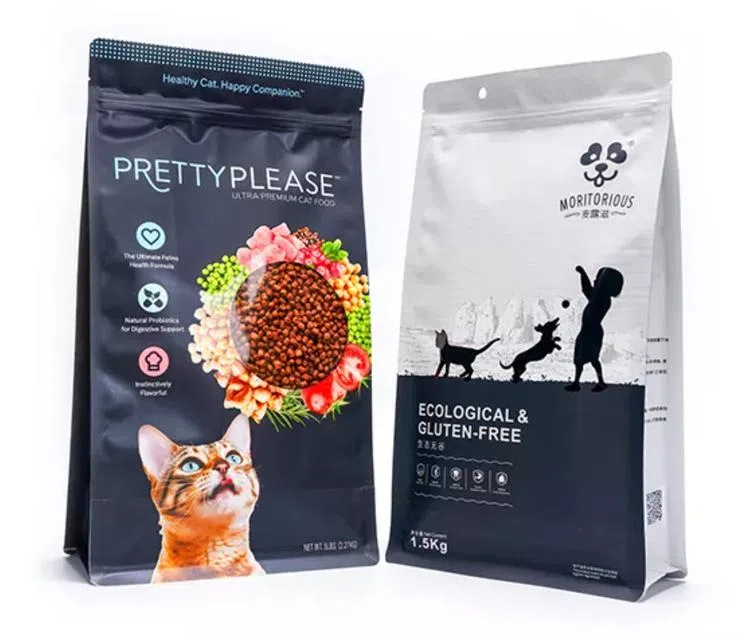
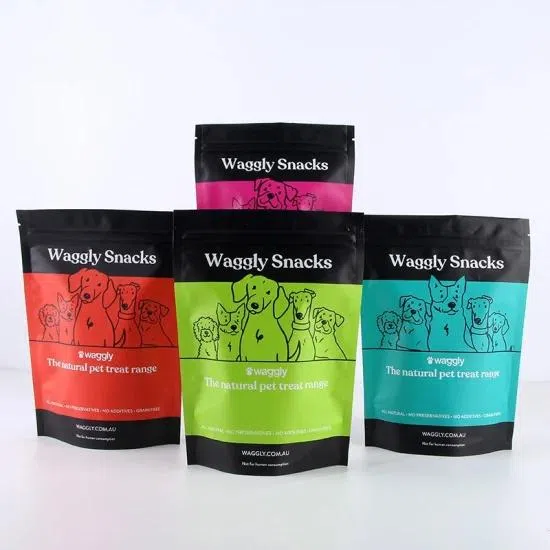
Final print quality also depends on substrate, ink, artwork, impression, tension, drying, operator settings and speed — not only the brochure sheet.
Cat food printing sample |
Dog food printing sample |
Application samples — results depend on press systems plus job conditions. PE film · BOPP film
A production-relevant print test on your material usually tells more than a specification alone. LISHG can map configuration from your substrate, width, colors, ink and target usable speed.
How to Choose a CI Flexographic Printing Machine
Before requesting a quotation, prepare the following information:
Substrate — Name the web and why it is hard at speed (e.g. thin PE stretch, PET heat in dryer, paper absorbency). That drives tension / dryer assumptions more than a checkbox list.
Material thickness — Send measured film μm or paper GSM with a sample roll; thickness drives tension and drying assumptions.
Printing width — Official options: 800 / 1000 / 1200 / 1300 / 1400 / 1600 mm or Custom (catalog band 600–1600 mm).
Number of colors — From artwork (often 4 / 6 / 8). Each added station adds register risk and dryer load at the same m/min — size those systems with the color count.
Ink type — Solvent-based or water-based; drying capacity must match ink, coverage and target usable speed.
Required production speed — Quote usable m/min on your substrate (not only mechanical max), and note what fails first today: register, dryness, or both.
Automation requirements — Automatic register, tension control, ink management, inspection, sleeve changeover, non-stop winding as needed.
Future production — Expected changes in substrates, products, widths, and volumes — size dryer and tension with growth in mind, not only today’s job.
Why Work With LISHG?
A CI flexo purchase is a production decision. LISHG sizes the press around the job — not only the model name.
| Decision input | What LISHG evaluates |
|---|---|
| Substrate | Stretch / heat / absorbency behavior and gauge window — not acronyms alone |
| Printing width | 600–1600 mm catalog band · common 800–1600 options |
| Colors | Station count from artwork — more stations add register axes and dryer load |
| Target usable speed | Match platform envelope to usable m/min after drying and substrate limits |
| Tension & register | Closed-loop web handling and auto register for film jobs |
| Ink & drying | Solvent / water systems sized to coverage and usable m/min |
| Automation & growth | Sleeve, non-stop winding, inspection — size for today’s job and near-term growth |
Frequently Asked Questions
What is a CI flexographic printing machine?
A CI flexographic printing machine is a flexographic press in which multiple printing units are arranged around a central impression drum. It is widely used for flexible packaging and other web-fed printing applications.
How does a CI flexo press achieve stable high-speed printing?
It combines central impression technology, web tension control, mechanical rigidity, servo synchronization, automatic register control, stable ink transfer, adequate drying, and process automation.
What is the difference between maximum speed and actual production speed?
Maximum speed represents the machine’s mechanical capability under specified conditions. Actual production speed is the speed at which the required print quality and registration can be maintained consistently on a specific substrate and job.
How fast can a CI flexographic printing machine run?
LISHG published envelopes: King mechanical 350 m/min with film-matrix recommended ~300 m/min; Master mechanical 500 m/min with recommended printing 400–450 m/min. Usable speed still depends on substrate, ink, drying and coverage.
Why can ~350 m/min be production-ready when ~500 m/min is not automatic?
Based on LISHG production experience, drying and substrate stability usually limit usable speed before the mechanical ceiling. At higher web speed, dryer residence time falls — so a King-class film job sized for ~300–350 can hold dryness and register, while a 500 nameplate without a Master dryer/tension package often fails first on blocking or smear. See the engineering profile table above.
How do I choose the right CI flexo printing machine?
Start from the substrate chain (stretch, heat, absorbency), then thickness, width, station count, ink and usable speed. Those decide whether tension, dryer or register is the first limiter — and which platform envelope can hold quality.
Can LISHG recommend a machine based on my production requirements?
Yes. Share the web behavior at speed (e.g. thin PE stretch, PET dryer heat), gauge, width, station count, ink, and usable m/min target — that is enough to evaluate a CI configuration around the real limiter, not only a model name.
Get a CI Flexo Machine Configuration for Your Production
The right CI flexographic printing machine starts with your production requirements—not simply the machine model or maximum speed. Typical RFQ fields:
| RFQ parameter | Official options / example values |
|---|---|
| Machine type | CI Flexo · Gearless CI · Stack Flexo (as applicable) |
| Substrate | Primary web + gauge (e.g. thin PE stretch risk, PET dryer heat, paper absorbency) — see substrate chain above |
| Material thickness | Send actual gauge with sample roll (film jobs commonly quoted from measured μm / GSM — do not use a generic brochure number) |
| Printing width | 800 · 1000 · 1200 · 1300 · 1400 · 1600 mm · Custom (catalog band 600–1600 mm) |
| Number of colors | Station count from artwork (often 4 / 6 / 8) — more stations = more register axes + dryer load |
| Ink type | Solvent-based · Water-based (match drying capacity to ink + coverage) |
| Required production speed | Usable m/min target on the named substrate (and what limits you today) |
| Main application | End use + substrate behavior (film stretch, paper set-off, woven surface variation) |
| Example match (catalog) | Example: stretchy food film · ~1000–1300 mm · 6 stations · ~300–350 usable → high-volume CI only if tension + dryer hold that band |
Based on these parameters, LISHG can evaluate the appropriate CI flexographic printing machine configuration, printing width, color count, drive system, tension control, register control, drying system, and automation requirements.
Conclusion
Stable high-speed CI flexographic printing is the result of an integrated system rather than one individual component. The central impression drum, web tension control, mechanical rigidity, servo synchronization, automatic registration, ink transfer, drying, and process automation must work together to maintain consistent print quality at commercially useful production speeds.
For converters, the most meaningful way to evaluate a CI flexographic printing machine is to connect its specifications with the actual substrate, application, production speed, and required print quality.
LISHG’s role is not simply to provide a high-speed machine. It is to help match the CI flexographic printing configuration to the customer’s actual production requirements.
Further reading: Speed bands 250 / 350 / 500 · CI flexo buying guide

